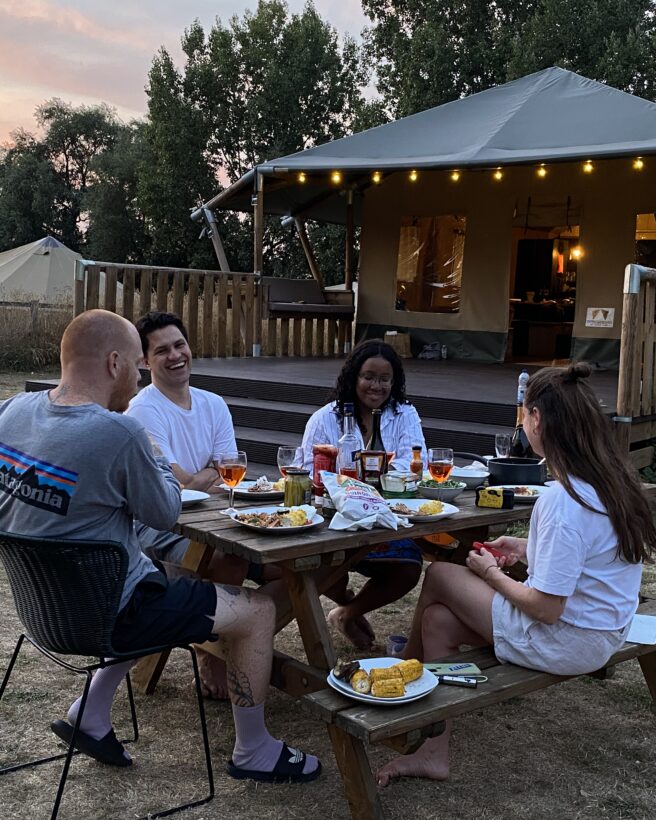
the image shows a group of friends sat around a picnic bench having dinner together
Image credit: Masuma Ahuja

What if changing the world could start at the dinner table?

The possibilities when we make space to eat, laugh, talk and dream together

I have spent the last few years in research and conversations trying to understand how we build models for community in an increasingly lonely and insular world, and what connecting with each other might unlock on a personal and a societal level. I can’t shake the conviction that a more connected world is a more prosperous and possible one. That maybe in losing the habit of being together, we lost access to all the possibilities we can unlock only with the unique combinations of all of our perspectives and skills.

The hard part is that community isn’t something any of us can engineer on our own, it requires buy-in, for other people to show up.

I turn to new social media apps, to supper clubs and members clubs, to publicly funded social infrastructure. All answering questions about how we scale the intimacy of a group chat. How we make that feeling of belonging something that’s baked into the world around us.

Somehow, though, the answer I find is often at the dinner table.

When I start talking to the people I know who love people, they all tell me about versions of the same. A friend who hosts monthly pot luck dinners for small groups of women out of a larger community of 80, an investor I meet whose superpower is connecting thoughtful people around the world by inviting us all to dinner whenever he’s in our cities, a woman who opens her kitchen to groups of strangers every few weeks for three years to build a community in a new city.

The point of these meals is rarely to solve a problem or engineer an outcome, but to see what happens when a bunch of unconnected people have the opportunity and space to eat and laugh and talk and dream together.

It’s at these dinners that I see engineers meet business people, artists meet policymakers, funders meet dreamers. Of the magic that unfolds when two different ways of looking at the world find common ground or complimentary solutions to the same problems. 

Maybe what we need, more than ever, are ways to come together, to find each other.

There is no shortage of good ideas, smart people, political and economic will to build the futures we dream of. Maybe what we need, more than ever, are ways to come together, to find each other. And maybe that can start at the dinner table.

The ideas that shape us

  • What is an idea from someone else that has shaped and inspired your worldview/practice?

    I recently read Adam Kahane’s book, Solving Tough Problems, about facilitating conversations with stakeholders from different political parties, interest groups, activists, and business leaders, to come together and shape the country’s transition away from apartheid.

    Reading about this process was transformative for me, showing me how we can bring together people who are often in opposition with each other and give them the tools, trust, and framework to start building and imagining a shared future together. Instead of a standard negotiation or diplomacy process which might place different parties in opposition with each other, each trying to maximise their own outcomes, this process was engineered to be collaborative. The point was to name a future they all wanted and work backward together to figure out what needed to happen to make this possible.

  • What is a piece of culture that inspired a shift or idea for you?

    A few different books that I’ve read recently that have shifted my thinking:

    Small Boat by Vincent Delecroix made me think hard about how a system ultimately is a collection of people, and is enacted by people. And about how much easier it is for people to have empathy for someone who feels like a person, not a number or an idea, to them.

    Unreasonable Hospitality by Will Guidara made me realise how making people feel seen is at the heart of most work, whether you’re running a restaurant or designing systems in a city. And the transformative power of embedding a sense of delight, not just utilitarianism, into the worlds or businesses we’re building. 

  • What is a project that you are most excited about that’s enacting change now?

    I’m most excited by the kinds of projects that are thinking about how to bring people together to dream and think in different ways. I meet people every week who are hosting supper clubs and salons in their homes. And I’m excited by every different kind of conference, art exhibit, or innovation program that brings that sense of play and collective imagination to life.

    I haven’t seen it in person yet, but I adore Lina Lapelyte’s We Make Years Out of Hours, which invites the audience to play and build using wooden blocks together. It really brings to life the idea that we can all make beautiful things together.

  • What has been an unexpected source of inspiration for you or your work?

    You might roll your eyes at me, but I live across the street from a construction site. I love watching buildings being built right in front of my window, every day. There’s something about seeing progress, about seeing people building things, that fills me with a sense of agency and hope. If I can, over the course of a few months, watch floor after floor of the building be constructed, then maybe year after year, I will also watch our world be shaped and built. 

  • What is an idea from someone else that has shaped and inspired your worldview/practice?

    I feel like I’m influenced by everyone I read and encounter! Some of the thinkers whose work I’ve been digging into (who I haven’t yet mentioned) are Mariana Mazzucato whose work has helped me think more clearly about how and what we value and how we think about building economies that serve us all, Priya Parker who writes about the power of gathering and offers thoughtful tools on how to gather well, and Rebecca Solnit, whose words always clearly articulate how transitional moments can shape societies.

  • Written by Masuma Ahuja

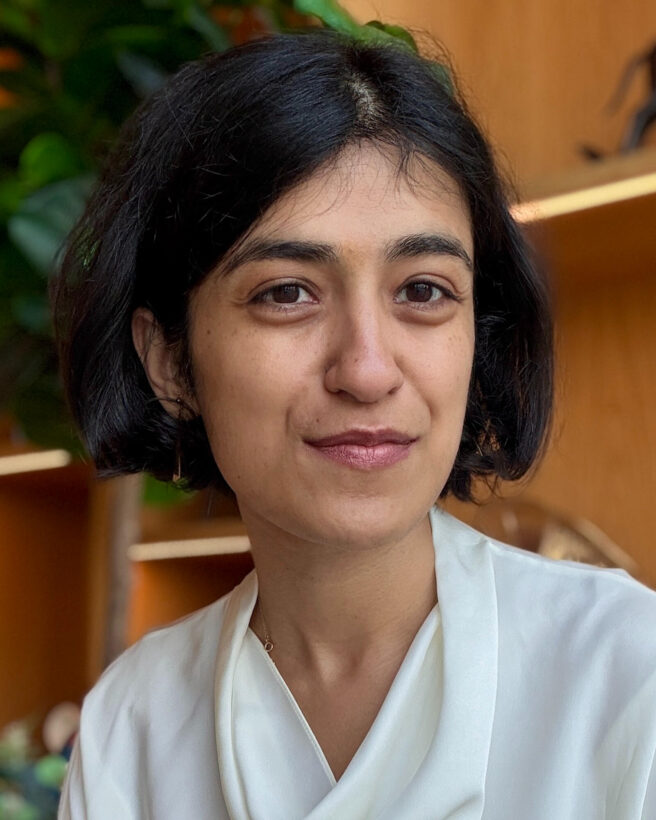
    Masuma Ahuja

    Masuma is a strategist and journalist. She’s led newsrooms, launched products, hosted podcasts and events, created museum exhibits, and built audiences of millions, working at The Washington Post, CNN, and Freeda. She serves as an associate for the Imperial War Museum and on the advisory council for More to Her Story. She’s the author of The Infrastructure of Belonging and Girlhood, and she shares in a Pulitzer Prize, Murrow Award, and Webby.

Read More