
Our Ideas in Progress format is a space to collect and share thoughts, visions and ideas from practitioners in the ecosystem. They invite us to dream collectively and learn to explore what it means to build in community.
How do we build thriving life that serves the whole when we see the sheer concentration of wealth and land in the hands of the few? With over two decades of work centring and resourcing climate activism, youth action, racial justice and health and healing, my heart keeps being called towards a mission that has been resonant across all my work: the need to return to re-indigenising and resanctifying (what are called) ‘resources’ back into the Commons.
What feels pertinent today is thinking about how we fundamentally transform our shared local and global ecology to govern and steward contextually coherent and globally interdependent local life-affirming infrastructures: life extending towards more life as our organising principle.
Life-affirming infrastructures is the generational commitment to transforming material and relational infrastructures, grounded in the Indigenous and spiritual technologies that train and cultivate our souls to be in right relations with ourselves, each other and this one precious life.
For myself and Healing Justice Ldn, life-affirming infrastructures is the work of discerning how the material and civic/public infrastructures that we inhabit sculpt and socialise our social and relational capacities (who and how we are and can be). That our material conditions and the physical infrastructures we are embedded in are tied to our emotional, mental and spiritual capacity, and give us a collective shape and spirit as a society. Therefore, our only way forward is to move into local, collective governing and stewardship, to reclaim and practice deep democracy.
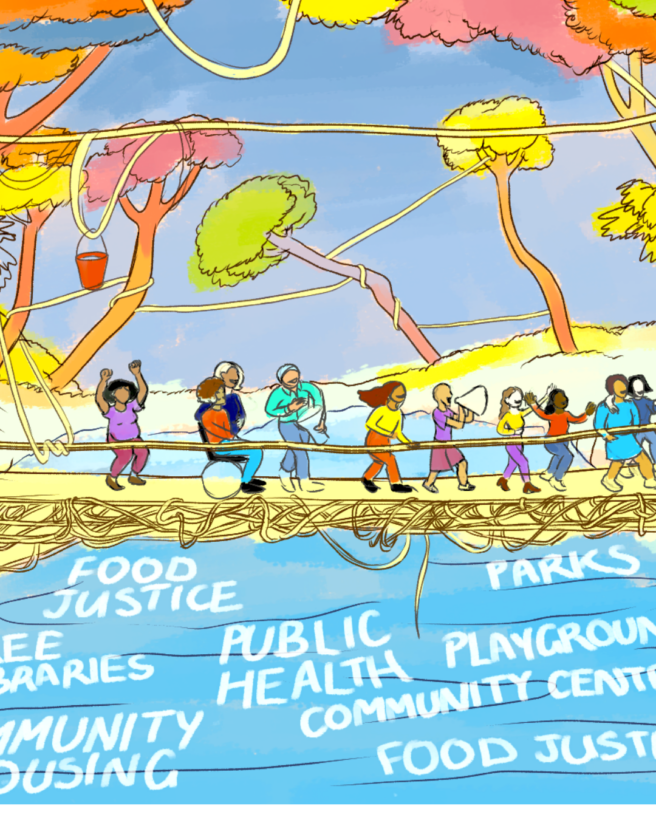
We have seen how the shrinking of civic and public life has contributed to the division and fragmentation of our communities. The loss of community centres, public and communal spaces mirrors the polarising, loss and threat to belonging felt widely across the UK. In this context, structural and material justice through building life-affirming infrastructures (local community stewarded provisions of housing, education, care etc) becomes a generational project of repair.
What infinite possibilities are possible when we design and build for growing and thriving life?
I intersect this with Ruth Wilson Gilmore‘s frame of ‘building meaningful infrastructures’ as abolitionist practice. Meaning, how we design and nurture the social and material conditions for life where people can exercise collective action towards shared flourishing amidst so much patterned grief, death and destruction.
I draw from the Islamic conception of أمانة [amana – entrustment], and my relationship to ecology, which is embodied perfectly in a commentary of Surah Al-Yasin:
“Ecology does not end at the border of our property, the national border of a country, or the border of the body’s skin. Ecology is multidimensional and universal. We each affect the entire global ecology and the world in turn, affects us. There is no separation.”
It means that the separation between the material and immaterial is a false binary and gap that we have to keep closing. It calls on us to turn away from notions of ownership, domination and capture. It is understanding who we need to become in this process, because our outer and inner transformations entwine. It calls on us to see land and our living ecologies as our sacred kin that are wise. And it encourages us to reimagine how economies can be transformed into circulating care, reciprocity, harmony and deep consent with all life, including humans.
It reminds us to be in the action and enquiry of what it means to be well, when our land, water, ecologies are sick. And it’s got me asking what infinite possibilities are possible when we design and build for growing and thriving life?