
Our Worldbuilding series connects the theory of systems change to the work being done on the ground.
This piece captures a moment in time in the Autumn of 2025, as experienced by three organisers; Evie Muir and Asma Kabadeh from Peaks of Colour, a Sheffield and Peak District-based community group, and Immy Kaur, from CIVIC SQUARE, a Birmingham-based collective*. Two organisations who, though operating within the same ecosystem, are at different stages of a shared fight towards Land Justice.
What it looks and feels like for us to be in this moment – the good, the bad, the in between – is delved into here. This piece hopes to dive into the details and swim amongst the contradictions. The depths and shallows that are rarely spoken to, that are hard to communicate alongside the polishedness of project launches, publications, film screenings, amongst the binaries of success and failure.
“We can’t only heal when it’s sunny” is a phrase I find myself consistently repeating to our Peaks of Colour community members. It’s a simple reminder that asks those who join our spaces to show up even on the days when our internal and external systems feel weathered and uninviting. With every utterance, it also serves as a personal mantra; reiterating to myself that I must embrace the lessons that reveal themselves under grey clouds, bloating with threatening rain, and dark nights, elongating into a depressive timelessness.
I fervently believe that this is when the depth of work in our movements takes place, and it’s for this reason why, each Autumn, Peaks of Colour goes into hibernation as a non-negotiable part of our organisational infrastructure. It’s a time of transition for us and so many of the organisers in our orbit similarly trying to hold on to their belief in what’s possible.
Some of us have received funding and are trying not to submit to the overwhelm, others are receiving their umpteenth rejection and are grasping at ways to sustain their work while under-resourced. Some are reverting to a slower pace in order to navigate conflicts and ruptures, while others are in the throes of relationship building and collaboration, energised with a spark of momentum. Some are juggling large communities, collectives and co-operatives where roles are slippery and undefined, others are figuring out how their practice can still thrive while adapting to meet the ongoing needs of small teams. Rarely are we given the space to lament in these nuances and entanglements or depict them in relationship with and to one another.
If I were a documentary maker, perhaps the conversations that follow would be screened as two side-by-side vignettes, showing how a moment within movements can be experienced so similarly and yet so differently. While the written word remains my mode of storytelling however, I hope to convey this here.
On seasonal organising
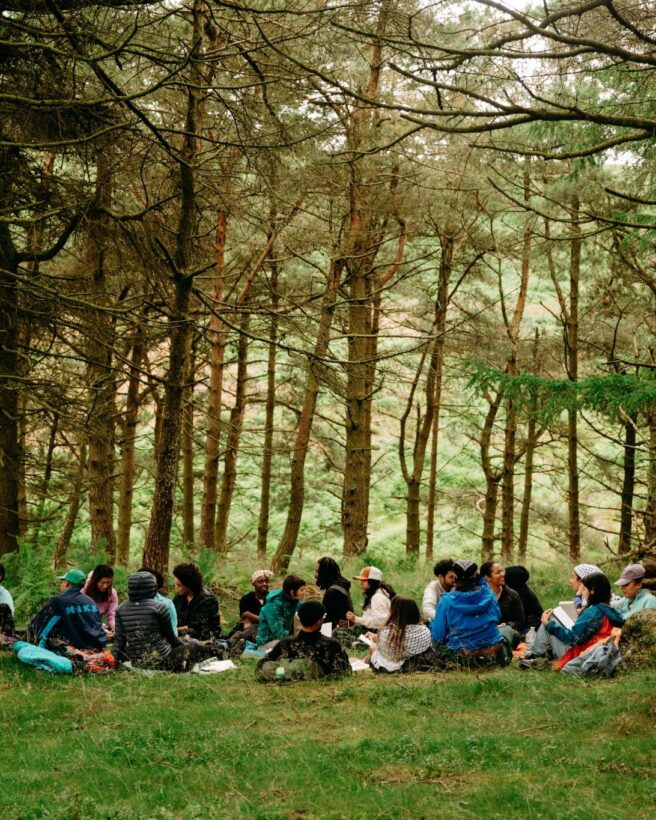
I write this piece as the founder of Peaks of Colour, a Sheffield and Peak-District based nature-for-healing community group by and for those with a lived experience of racial and gendered trauma. We curate creative, holistic and collaborative spaces in which we explore alternative routes to healing and justice. After five years of organising, we are now emerging into the official visioning and dreaming stage of an ambitious Research and Development Project which aims to build collective capacity at the local scale.
Official in that, though it has been percolating in our minds for some time, this work is now fortified by the backing of a handful of funders, allowing it to be resourced as something tangible and textured that we can invite our community to shape with us.
To delve further into this moment, I speak with the person I am blessed to do this work alongside, Asma Kabadeh. An expert weaver of people and places, Asma joined Peaks of Colour in 2024 as our Soma Sessions Producer, and is now the co-curator of our as-yet-untitled ‘Land Justice Project’, a project dedicated to finding and building a home in the Peak District for our Black and Global Majority communities.
The conversation takes place in my living room. The end of the year is approaching and it feels like we’ve crawled here.
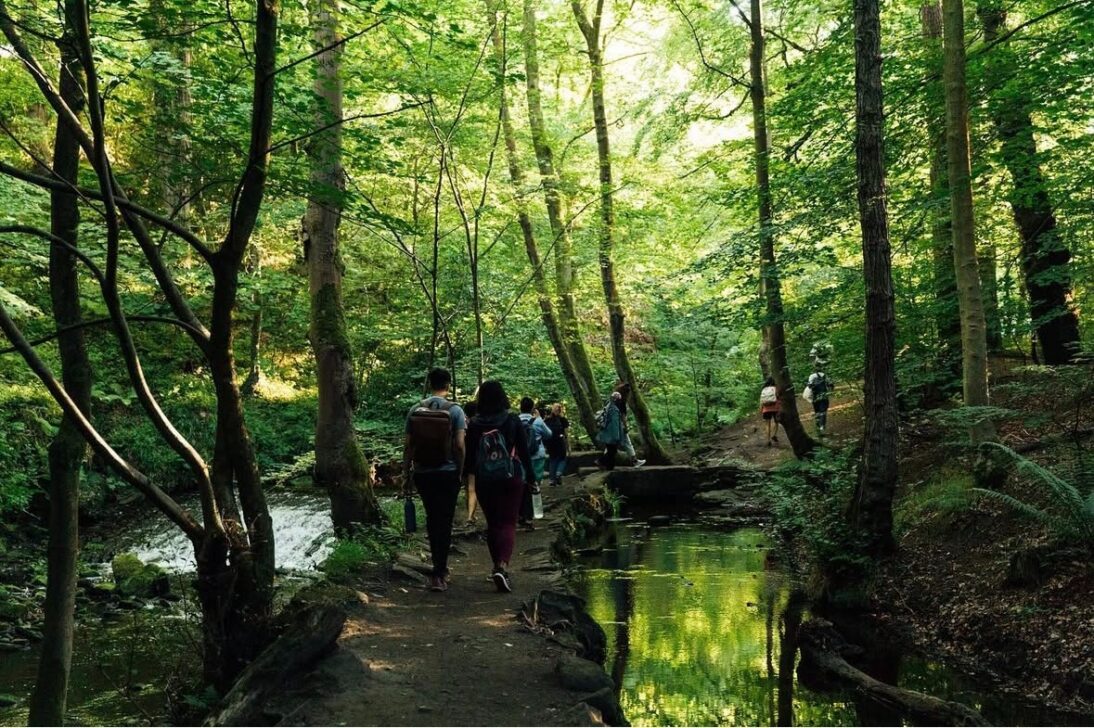
After 12 months of gruelling funding applications and soul crushing rejections, we were able to end the year safe in the knowledge that we’re going into 2026 with something. Nowhere near enough for us to be fully resourced, but resourced enough to make possible a dream that at times felt too ambitious to become a reality.
In this moment we feel like we can exhale. Not quite celebratory, and not yet energised into action. It’s a lofty state between overwhelm, anxiety, disbelief and excitement. After fighting so hard and advocating so relentlessly, it’s now real and it’s intense.
Asma shares: “The one thing that makes me feel better is knowing that this is long work. That we can start small and hone our skills through prototyping and rehearsing as we continue to experiment towards the future”.
The glass-half-full one between us, she doesn’t linger on the uncertainty for long before diving into all that is optimistic. “I’m looking forward to exploring how we could potentially build something truly off grid, that can regenerate itself, and that isn’t extractive but in fact beneficial to the land,” she continues. “Maybe what excites me the most though is that whatever it turns into, we’re dedicated to it being a community build project and that this collective effort will have really constructed something that can be sustainable.”
Navigating the violent present
We dance between the positives and negatives. My exhausted mind, brewing with every possible way that this could go wrong, brings a sombre note to the discussion. I share my fears around the right wing fascists we know have been organising in the Peak District.
In 2020 they took to a popular hiking spot, Mam Tor, and brandished a ‘White Lives Matter’ banner, and while they’ve since been organising mostly underground, they occasionally remind us that their status remains active, through St George’s flags, campaigns and leaflets promoting the ‘indigenous sovereignty’ of white Brits.
I wonder out loud: “How do we do this work in a way that keeps us safe amidst all the ways that whiteness can manifest? The fascist far right who’d want to annihilate this idea, those with more power and economic resources than us who could easily co-opt our plans, all the systems and institutions we will need to negotiate with in order to move into something greater? Access to land makes us a threat to every facet of racial capitalism”.
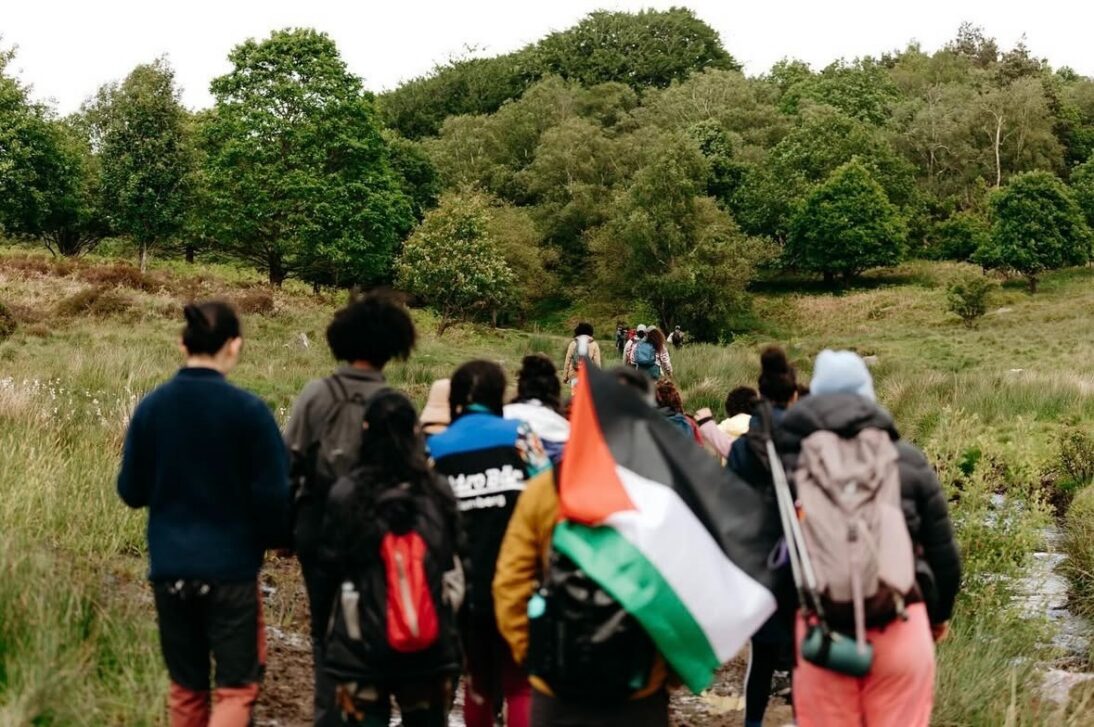
Asma, adept at moving with the way my brain has a tendency to spiral, reassures me. “When we started off as a walking group, I remember walking past other groups with all white members and realising the intentionality behind every footstep we were making. I remember feeling that growing confidence that we all shared, and it’s that same confidence that’s brought us here.”
Building worlds, for us, by us
Putting down the politics that haunt this moment, we instead choose to pick up the practices we have been nurturing that have prepared us for this new venture. At Peaks of Colour we’ve been exploring how a redefining of ‘community responsibility’ and ‘organisational responsibility’ can hold us in this moment. For us, the former can be understood as a radical invitation and a reciprocal offering, while the latter becomes the container that holds us as leaders accountable to our Black Feminist and abolitionist ethics.
“Trusting our own communal, ancestral, spiritual, cultural and ecological knowledge to interpret it in a way that defines ‘Land Justice’ for us, is just as big a task as the upskilling element,” Asma shares. “When there’s nothing that’s already for us, it almost feels like you have to reinvent the wheel, in order to create something that actually feels right, for us and something that’s suitable to an arable climate, for the land.”
Our eyes meet and brows raise as our heads slowly nod, taking in the scale of the task ahead. It’s hard to tell from the recording, but in the background one of us whispers… ‘Fuck’.
Journeying together
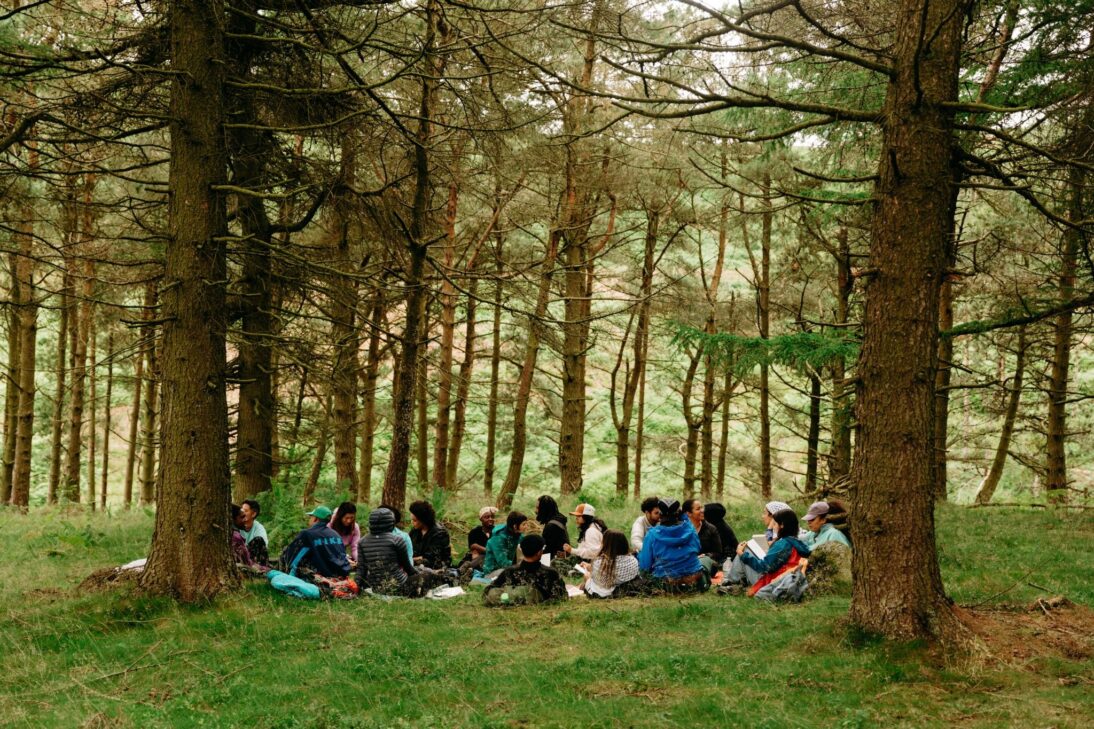
There’s a skill in being able to hold both the present and future in the way that Asma speaks of. It requires an embodied fortitude rooted in self-belief, openness and adaptability. As Peaks of Colour readies ourselves for this challenge, one thing I’m grateful for is the numerous ecosystems of organisers that we’re part of, who every day show us what it is to tend to this work with integrity and intentionality. CIVIC SQUARE is one of them.
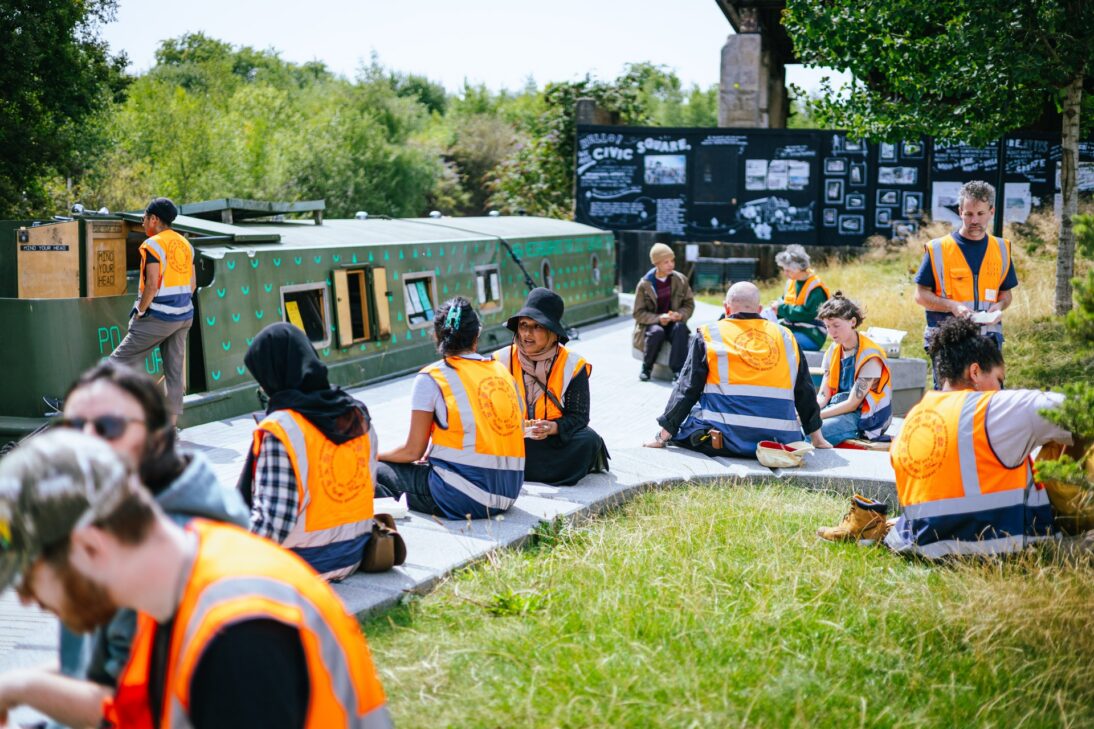
While we are nurturing our vision into a viable proposal, CIVIC SQUARE is transitioning into the build stage of this work. With a former-industrial plot of land acquired as a freehold in the Birmingham area of Ladywood, they are co-developing a Neighbourhood Public Square: a site in which they will repair, build, adapt and maintain regenerative civic infrastructure alongside their community.
Having been fortunate enough to visit over the years, I’m always floored by how a linear temporality is manipulated on the land they’re organising from. The future feels close.
In a context where half of England is owned by less than 1% of the population, the conditioned detachment and disempowerment communities feel when it comes to accessing, nevermind stewarding, land cannot be underestimated – nor can the immensity of the incremental successes that counteract this narrative that CIVIC SQUARE continue to provide.
I know many organisations, Peaks of Colour included, look to CIVIC SQUARE for inspiration and direction, as an organisation that is vehemently evidencing what is possible. Catching up with Immy over an online call, I wonder if there is a certain pressure that comes with holding that pioneering position.
“I don’t find any pressure with anybody looking at us for hope. I’m very grateful for the chance to be doing this work, especially in the current global context,” Immy states. “Looking to us to forge every new idea, answer every question as if we’re perfect is when the pressure feels disproportionate. I always try to be honest, but what I find hard to communicate is all the contradictions, the challenges, the incompatibilities, the discomfort”.
When it comes down to this work, there is no ‘predictable’. There’s only emergence.
This is something I’ve also struggled with, and I share that “how are you?” has become the most difficult, vulnerable and exposing question to answer. “I cried on the way here because we got another funding rejection. I’m struggling to stay present when the future feels so uncertain”, I want to say, or “This week I overstepped my boundaries and access needs in order to make this work more accessible for our community. I don’t know how to make it safe for all of us”.
Speaking with Immy, I realise that I’m not the only community leader grappling with this. She reassures me:
“We can’t spend our days seeking comfort when we’re sitting within the Western Imperial belly. Western ideologies, particularly the industrial processes, allowed us to believe in a type of ‘predictability’, while the impact of that human-made industrial imperialism on our environment means that we’re actually navigating very unpredictable climate cycles. We’re in chaos. And so when it comes down to this work, there is no ‘predictable’. There’s only emergence.”
Infrastructural emergence
I think about Peaks of Colour’s Land Justice Project. We received two years of funding to create our 75-year vision. There’s a cruel and painful irony here, that communities are given the opportunities to dream and really name what they need without any guarantee that there will be the long-term resourcing required to actualise it. Each year my personal resolution stays the same: try to stay present.
“We have one foot in extractive capitalism and one foot in the future, not fully sitting outside the current system is intricate,” Immy tells me, reflecting that this hasn’t disappeared as their work has evolved, it just grows alongside it.
We have one foot in extractive capitalism and one foot in the future
“This complexity translates to every level of the work, both in the ways we negotiate with institutions, and how we organise at the interpersonal level too, holding the need for adaptability in service of the work, whilst also the need for personal and collective security in order to be resourced to do the work at all.” She continues.
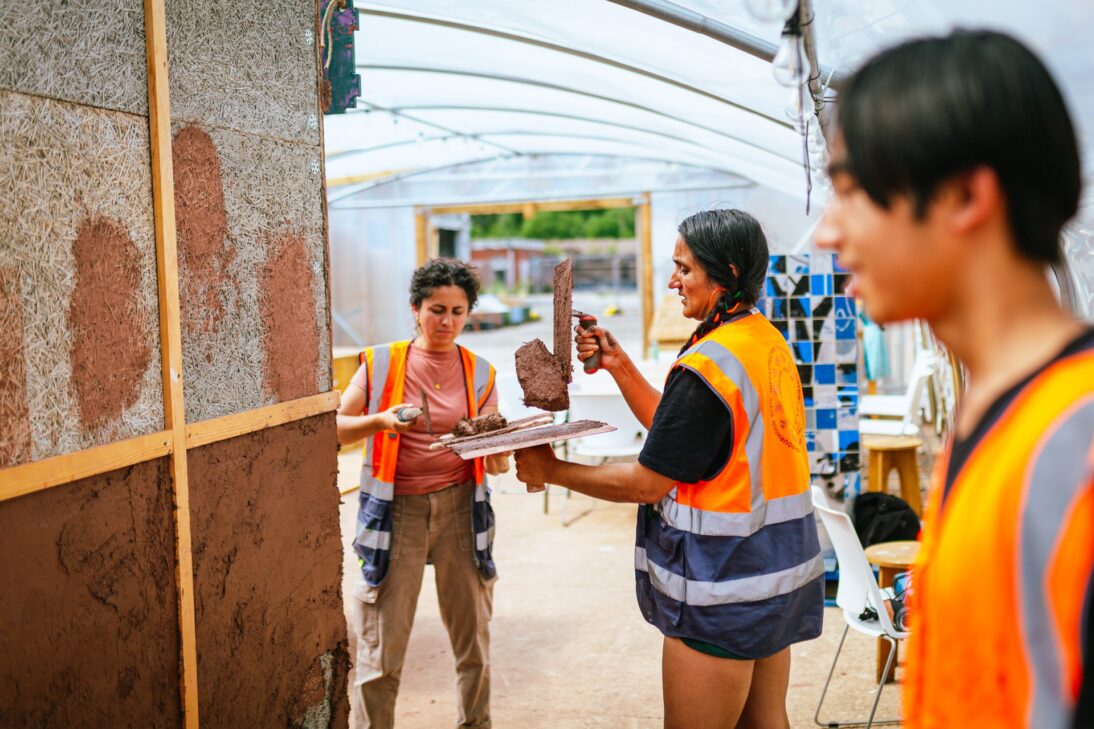
“How can we create just enough structure within to hold the fact that liberatory work can also be what pays our bills? Taking on new sites is bringing interesting dynamics about the skills, labour and work that is needed, whilst also trying to make it equitable and caring. It requires constant upgrading, constant reimagination, of how we organise, of our roles, of what we’ve learned and what we do next.”
Staying with the complexity
Though the intricacies of this work may be sticky and swampy, earlier in the year Immy shared a post on her personal Instagram story that resonated with me. In it contained the realisation that she and the CIVIC SQUARE team are currently living the dreams that they manifested years ago.
I’m interested in what emergence looks like for CIVIC SQUARE at this time of the work. One thing I’ve always felt awed by is the way they are able to dive into the granularity of the now and utilise every skill, energy and resource to create magic moments in the meantime and the meanwhile.
Immy explains, “We’re about to build a building. So we have to consider how each piece of material that we use is either an act of global solidarity or global degeneration, because every mineral and material has a direct impact in other countries where we’re extracting those building resources from. You also have to genuinely believe – in your chest, in your heart, in your spirit – in the thing that you’re building. Every choice is a fractal of the world you want to see.”
Building on this, I asked Immy how she’s creating space for celebration and being present in the enormity of this moment.
“We have some ingredients. The main one though is really radically long-term, trust-filled relationships. I’ve worked with some of our directors for 15 years for example. Finding the people that you’re going to go through the long haul with, knowing that what we don’t do is break apart.”
When I ask what of this moment do they think they’ll similarly be able to look back on in celebration 10 years from now, Immy foregrounds a hopeful response with a healthy dose of reality.
“The climate science points towards something I don’t think our movements in the UK are viscerally connected to, and that’s that in 10 years time, the wider context isn’t going to be glorious. I think there’s going to be a big battle between machines and humans, between extraction and regeneration. It’s going to be incredibly hard and violent for our communities.” She pauses.
It’s a brief pause, but it’s long enough for Immy’s predictions to touch a vulnerable place within me. As someone who has navigated mental health conditions that cause suicidal ideation to be a dominating part of my daily life, I struggle to hold the sinister truths that Immy speaks of. Not because I deny their validity, but because renewing my commitment to this work is a battle I undertake with myself every morning.
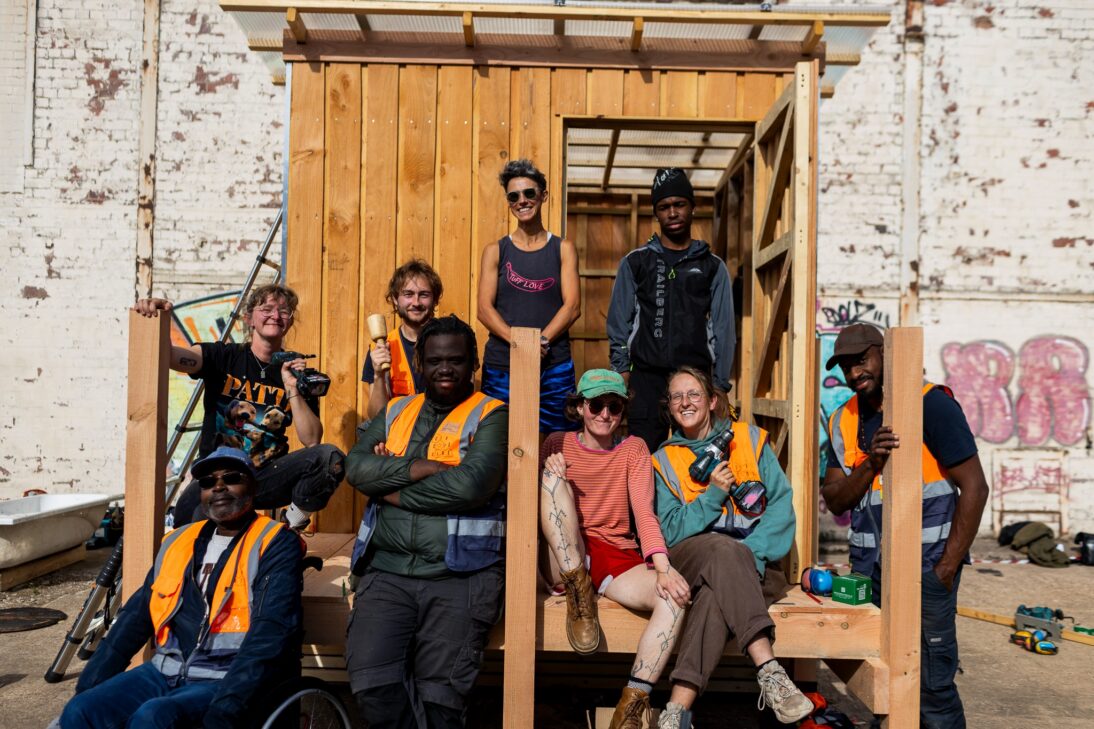
Building a home for our communities in the Peak District is a commitment to my aliveness, and the aliveness of my community, local and global as well as to the aliveness of this earth. This is something that the state, the far right and funders will never understand, but I know Immy does. Within moments, she pulls me out of the doom as effortlessly as I had slipped into it.
Building a home for our communities in the Peak District is a commitment to my aliveness, and the aliveness of my community, local and global as well as to the aliveness of this earth.
“For me, CIVIC SQUARE and Peaks of Colour’s work is about building things as if we believe we are going to win. I try to hold these things together. The beautiful, hopeful vision is what we lead with, and a deeper, more honest look at where we’re at, is what drives the pace. A pace that resists the fact that we’re being out-organised by the right and that is driven by the desire for future generations to feel safe. Where future generations are standing next to us in the middle of thriving Civic Square and Peaks of Colour sites. Places where resilience, mutual aid, care and resistance to authoritarianism, fear and division can be born. And if a bad day comes, these are places that provide us with these places of sanctuary and healing that we can rebuild from.”
On being our younger selves’ wildest dreams
As I write this piece, snowdrops are budding through the earth’s thawing surface. We’re moving from deep Winter into the first signs of Spring, and I revisit these conversations after burning out shortly after they were held and taking two months off to hibernate as a result.
Revisiting our conversations in this new moment, I’m struck by the weight we were all carrying and wonder whether this feels any more easeful now that the blue skies above us are more frequent. Maybe, but, given the relentless horrors of local and global politics, maybe not. One thing that resounds loudly in these interviews however are the voices that feel present but not named; the younger versions of each of us and the experiences that little Evie, Asma and Immy experienced that have informed who we are and the work we’re doing today.
“I grew up as a young person in Sheffield’s community spaces – my auntie used to run one – and it always felt like there were a lot of resources available to me because of this.” Asma tells me, musing on the incomprehensibleness of this full circle moment: how she started going to community centres as a child and embarks on building them as an adult.
“It feels intentional, because it informs the work that I do and how I do it.” she says. We discuss the landscape of community-owned and led spaces that still exist in Sheffield. Many were set up in the 80s, but, as Asma has witnessed, many faced closures. Now, it feels almost impossible for anyone to create a new space, and the ones who have survived – ISRAAC, SADACCA and Firvale Community Hub for example, continue to struggle to sustain themselves.
“It’s strategic: underfund spaces, force spaces to close, blame communities. And as a result, so many of the central hubs where people experiment, explore, build community and organise are gone,” she says.
Unlike Asma, growing up in Doncaster there wasn’t a wealth of community centres in our local neighbourhood. Instead, the streets became my playground and fortunately, all the roads within one of the most underprivileged villages in the town, led to a park which sat upon the River Don. Here my world opened up to a whole ecosystem of adventure and a connection to land that I didn’t have the language for at the time. It’s that childlike wonder and sense of sanctuary, combined with Asma’s memory of thriving community spaces and fortified with the robustness of intentional practice, that the image of Peaks of Colour’s future is built on the back of.
Immy on the other hand, finds continual inspiration in the ethics and stamina required within the athletics that defined her childhood. “I often use sporting analogies,” she laughs, “I use my sports brain to make sure we do the thing, we complete it and we win, or we do really, really well. And then I use the community theory part of my brain that holds that what we’re doing feels like a fractal of the global and local solidarities that we’d want to show. The balance is knowing that we can’t solve everything, that’s what makes this generational work.”
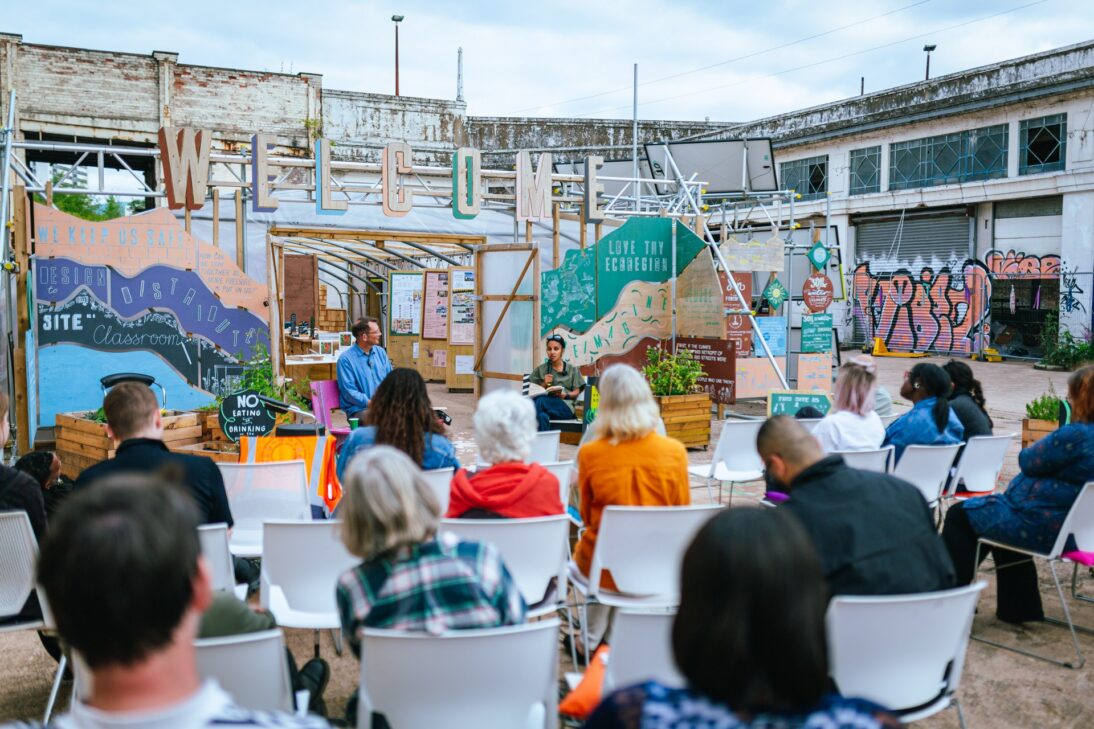
Through these conversations, I’m reminded of what ‘generational work’ really means. That it not only refers to the future generations that our commitment to Land Justice is in service of, or the past generations that we are continuing the work of. It also refers to the younger generations within us.
Much like the social media trend where people share a picture of themselves as children, accompanied by the caption “this is who you’re being mean to” to encourage self-empathy, there’s something about sensing the younger versions of each of us in these conversations that evokes: “this is who is trying to make the world better”.
It’s these younger versions of ourselves that sit behind the visions, that are holding the complexities, that are navigating the struggles, that are showing up to fight, that are building our physical and emotional capacity for the labour this work entails, and that are waking up each morning and renewing our commitments to new worlds.
In this moment, I’d like to make space to honour them, before we return to the work.
*I had also hoped to speak to Eshe Kiama Zuri as a third interviewee for this piece. Eshe is a Nottingham-based organiser and the founding member of the Nottingham Nourishment Network – a community garden and library rooted in the ethic of Ital abundance. The land they grew on sat at the back of a private school. When this school failed its Ofsted reports and was forced to close, Nottingham Nourishment Network also found themselves evicted, just months after they had laid their roots. I had hoped to catch up with Eshe about this process; the precarity of organising on white-owned land, the impact of starting over, and what shapes their work is now taking after this upheaval. When Eshe gave birth to their first child last Autumn, the nurturing of new life – and all the intimacies and intricacies doing so entails – understandably took precedence. I include this context here, to name all that continues to grow in our movements out of sight.