Full transcript text
My name is Andrew Sage and I'm a writer from Trinidad and Tobago. You are listening to A World With and in this episode, I'll be adding libraries of things.
Right now I'm nestled in the northern range of Trinidad where forested mountains hug urbanised valleys. I'm recording this episode following a downpour of rain. Due to our ongoing wet season, birds sing as they dry their wings. Thunder still rumbles in the distance, and cars and planes carry on regardless.
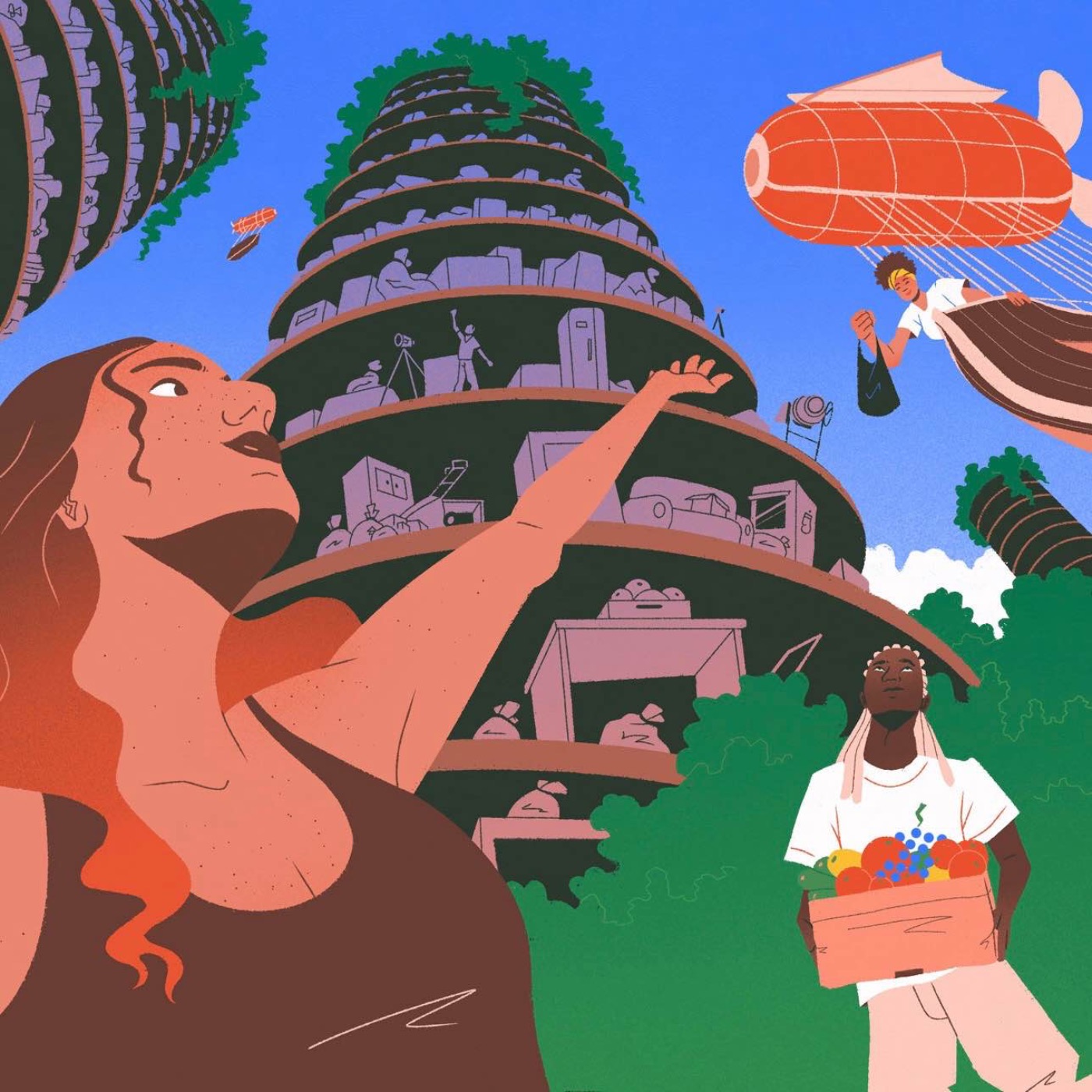
On our journey to liberation, my contribution to the world are libraries of things. So what do I mean by a library of things? A library is a building or room that holds books, periodicals, and digital resources for people to read, use or borrow for a fixed period of time, and then return. In a world with libraries of things people could share, borrow and use various things like kitchen appliances, furniture, vehicles and more for as little as a few hours to as long as a lifetime, returning them to the commons when no longer needed so that others can appreciate them too.
I would also describe a library of things as a form of commons, a way to share the abundance of various things without paywalls or property restrictions so that everyone can have access to the resources, tools, and spaces.
We need to define what a good life looks like for each of us. We live in a society where everything from basic needs like housing, information and culture have become things we must rent or pay for. Scarcity has been constructed by property owners for their profit, despite the fact that everything we need to live comfortably from food to shelter to clothing is already abundant. But the ruling class, politicians and capitalists alike have successfully kept this abundance. They've created laws around property that concentrate their wealth and control over land, resources, labour and culture. This has led to a situation where so many of us have no other choice but to sacrifice our time and energy to the grind, just so that we can meet our basic needs and find small comforts in consumption.
But this state of affairs is not sustainable. We’d need approximately 1.78 Planet Earths worth of resources just to support our current global rate of consumption and waste. Which means if the whole world consumed as much as the US, we’d need approximately 5 Earths.
If the whole world consumed as much as the US, we’d need approximately 5 Earths.
If everyone consumed as much as the UK, we’d need approximately 2.5 Earths.
Every year, we vastly overshoot our planet’s capacity, in part due to the disproportionate impact of the world’s wealthiest 10% and in part due to the way our current system has been structured to make us all culpable through our individual consumption.
Inequality, overconsumption, and artificial scarcity are the result of this system prioritising profit over collective wellbeing and ecological sustainability.
For as long as I can remember, I’ve been frustrated by just how easy the solutions to these problems appear to be, yet how many obstacles needlessly stand in the way.
Inequality, overconsumption, and artificial scarcity are the result of this system prioritising profit over collective wellbeing and ecological sustainability.
As a child, I saw that the world had enough food, enough space, enough things. In the big books of knowledge I read, I learned how much food we grew and wasted, how much land was stretched across the Earth, and how many mountains of waste we generated. When I went to the malls, my mind spun with just how much stuff there was available even on my island. I saw mansions in person and on TV. I saw BMWs and Audis driving past vagrants on the street. I saw that some people hoarded more than they could ever need while others scraped by with little to nothing.
I spent my days in the library in Port of Spain, Trinidad wondering why tools, toys, houses, and more couldn’t also be as accessible to all. Like so many of us, I grew up on the message that “sharing is caring” from parents, teachers, and peers. Yet the world we’ve built is so antithetical to this basic value.
I believe in, and want to bring libraries of things to our world because they represent a necessary shift in our priorities away from artificial scarcity and absurd overconsumption.
I believe libraries of things — like the libraries that inspired them, the libraries of my youth — offer a whole world of possibilities once we shed the ridiculous notion that all things should remain the exclusive domain of private owners.
When I think about how beautiful and freeing libraries of things could be, it brings tears to my eyes.
Imagine being able to explore new hobbies and try new instruments for free.
Imagine being able to repair your own stuff and build new things with the tools and resources available at your local library of things.
Imagine being able to furnish and decorate your home without breaking the bank.
Imagine being able to live comfortably without having to worry about rent.
All of this and more is possible when we open up the commons and share the abundance through libraries of things. Libraries of things could enable sharing within apartment blocks, neighbourhoods, cities, or entire regions. They could open up new spaces for common use, from gardens to theatres to studios to kitchens. Through their broad and growing collections of stuff and spaces, they could give us the freedom to live fully and vibrantly.
So how do we start libraries of things? Smaller-scale libraries of things already exist in some places. If there’s one near you, see if there’s anything you can do to support them.
But if we want libraries of things to reach their full potential, we need to create more of them and link them together to form a web of commons for a better future.
If you’d like to start your own library project, start by finding others who share this vision. Together, you can pool the labour and resources you’ll need. Maybe you can start with creating an art supplies library or a tool library. Or something else entirely.
Do your research on what’s needed in your community. Gather donations and raise funds. Start small and grow from there, in whatever location you can find to base your operations.
Libraries of things are a crucial step in a much broader social revolution that will transform the conditions of our society and meet the needs of all.
Your library might get started at a school, a shed, a storage closet, or a room in a public library.
Launch events to cultivate trust and build support for the cause. Be dynamic and ever-evolving as the project grows. Whether it starts at the scale of a circle of friends or serves an entire community, with a little bit of effort on all of our parts, we can turn this vision of abundance into a reality for all.
I believe that establishing libraries of things are a crucial step in a much broader social revolution that will transform the conditions of our society and meet the needs of all.
If we link up these efforts with broader social struggles for political, social, and economic change, we can reach the full potential of this idea and liberate not just humanity, but the entire planet from the shackles of this political-economic regime. As we create these libraries of things, we will develop practice in organising ourselves, counteracting injustice, and pursuing freedom.
I believe libraries of things have the potential to forge a way forward for humanity, without the poverty, inequality, and waste that has been normalised to us today. We all have a role to play in creating the library economy of tomorrow. Together, in a world of libraries of things, we can enjoy true and sustainable abundance.
My name is Andrew Sage and that's what a world with libraries of things would sound and feel like.
I can't wait to see what else we’ll add in the next episode. Thanks for listening!
A World With is an audio series produced by Futures in Draft and Storythings.