
Power of Place is a personal essay series that explores the transformative power of places around the world and how they are being used by communities as sites of resistance and worldbuilding.
In this article US based writer Ning Chang, explores how activists in New York City are fighting against ICE and building support for migrant communities.
There were two other people standing outside of Courtroom 24. Across from me, a woman wearing wire-rimmed glasses and a green cardigan, and next to me, a man with a ski mask pulled over his face, a hat pulled low and sunglasses blocking out the fluorescent lights.
He wore gloves and flipped through a stack of printouts, marked in black Sharpie, that had pictures of men and women. When he got to the end of the stack, he started again from the beginning.
Outside the courtroom next door stood another identical looking man. The next door, another. They lined the hallway doing the same rote shuffling motions, some with their fingers hooked into the straps on their bulletproof vests.
There was a murmur in Courtroom 24 and my ears suddenly perked up. Through the open door, I could hear a judge speaking, overlaid with the digital crackle of an interpreter.
Do you understand that your case has been dismissed?
¿Entiende usted que su caso ha sido desestimado?
I locked eyes with the woman, who wrapped her cardigan tightly around herself as she began to type. I was almost certainly sending the same message to a similar Signal chat.
Dismissal in 24. If anybody is nearby, we need escorts NOW.
As a wide-eyed older man in a Sunday suit exited the courtroom, clutching his backpack to his chest, masked agents descended on him. In tandem, a disparate group of courtwatchers rushed to help.
Dismissed and disappeared
Courtwatchers are people who volunteer at the immigration court, sitting in on hearings to assess if courts are working fairly – an essential part of the democratic promise of a transparent justice system. Many of them are activists in the immigration space, tracking abuses and miscarriages of justice from before the Trump era. Today, they support comrades who find themselves in the crosshairs of the US Immigration and Customs Enforcement, otherwise known as ICE.
I first found out about courtwatching through friends – and soon after I was invited to join courtwatching shifts.
As the man was escorted from courtroom 24, an attorney with a slick back blonde bun and a pink jacket, an avenging Elle Woods, attempted to clear a space around the doorway. One of the courtwatchers, a rabbi, put their arm around the man as gloved hands reached in between them, calling out warnings for obstructing law enforcement.
And everywhere, people with phone cameras were taking videos, attempting to get the man’s name, the contact information of his loved ones. Anything to make sure he didn’t disappear without a trace when the masked agents sealed him off from the crowd and wrestled him into an elevator.
“Flood the zone”
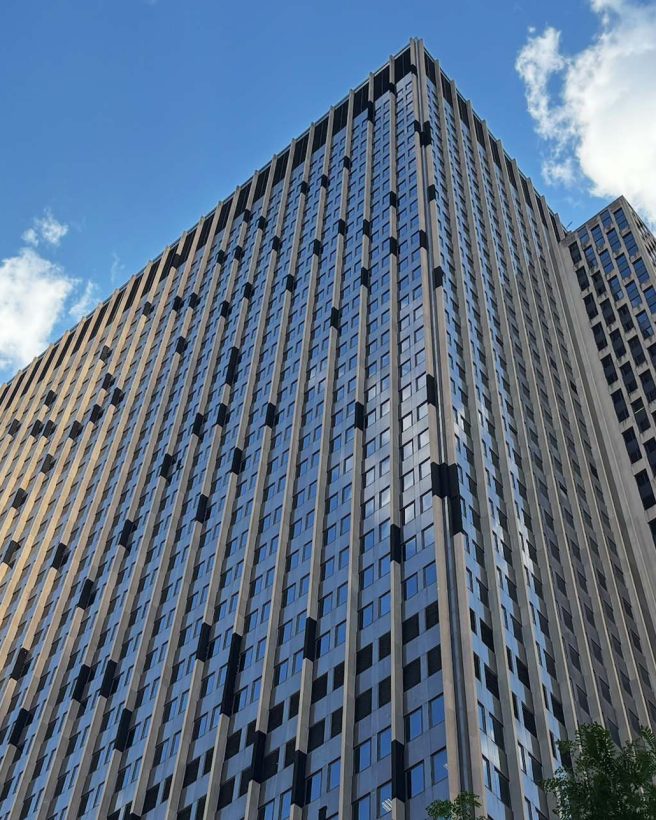
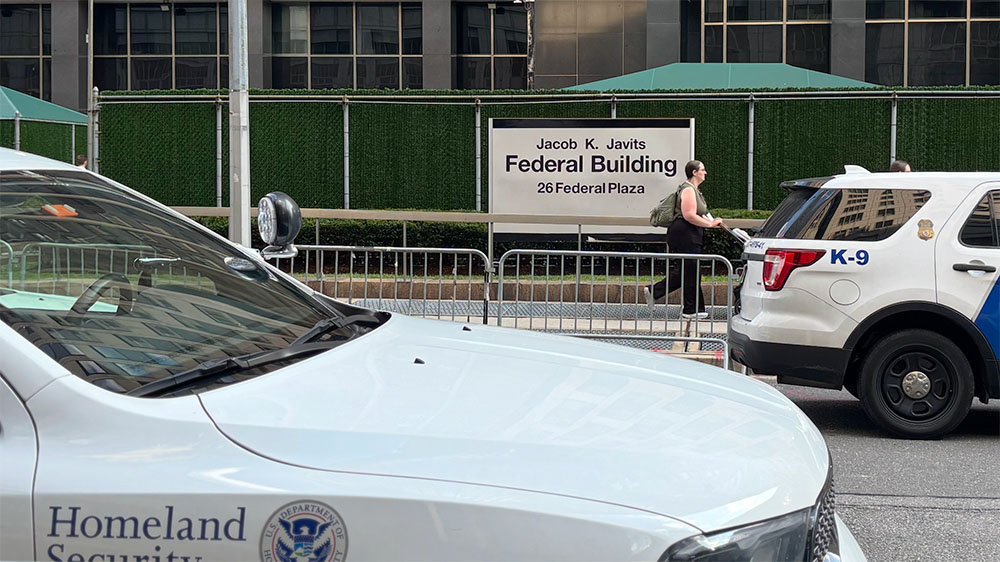
This is the 12th floor of 26 Federal Plaza in Lower Manhattan, home to federal immigration courtrooms.
Every day, hundreds of people arrive for regular check-ins, court hearings or administrative procedures. Dozens of them never leave of their own accord, forced instead into pathways of detention and deportation.
As gavels fall, and cases are delayed or dismissed, agents of the federal government attempt to arbitrarily kidnap men and women, even children, the second they step over the threshold. Sucked into the black hole of Federal Plaza’s 10th floor, where dozens of people are trapped without beds, showers or adequate food, they reappear days later across state lines in private detention centers in New Jersey, Florida or Louisiana.
Federal Plaza is the New York epicentre of Trump’s deportation agenda, a nationwide web of terror perpetrated by ICE and the Department of Homeland Security (DHS).
Deportation czar Tom Homan and Secretary of Homeland Security Kristi Noem made promises to “flood the zone” in a sweep that has detained and deported grandparents, mothers, fathers, high school students, six year olds with leukemia, and legal residents. With anonymous armed agents employing unlawful tactics, bolstered by a budget exceeding the UK military’s, they are more accurately functioning as a secret police force.
The hallways of Federal Plaza are a landscape of cruelty and impunity – of the police state flexing its muscles, and of a steady authoritarian drift eroding rights and freedoms of minoritised communities. As judges and attorneys argue the letter of the law, due process rights are being trampled into the scuffed linoleum just outside. Two floors below, habeas corpus withers away.
Papers and empty promises
The last time I was in Federal Plaza, just over two years ago, I was an immigrant. I came for my naturalisation ceremony where I received a certificate, a pamphlet on how to register to vote and a mini American flag. But like many others, I felt I was an immigrant in papers only. All I’ve known is New York City, the playgrounds on the East Side as a kid, the thrill of buying a shaved ice from the piraguero after school, the smell of the windows fogging up on a rainy crosstown bus ride.
Sometimes when I come to courtwatch, I cross paths with new citizens with their own flags. The only difference between them and others on the 10th floor is a piece of paper.
Only a few things determine whose rights are stripped away and ground under the gears of American fascism, and whose are preserved. And as ICE enforcement increasingly indicates, paperwork doesn’t matter. Ultimately what now matters is the colour of people’s skin: Who sees Federal Plaza as a trap, and who sees it as the final threshold to becoming a protected American citizen.
But protection for whom? Citizenship did not swoop in to defend a two-year-old who was deported to Honduras with her undocumented mother. It did not protect Sayfollah Musallet, a 23-year-old from Tampa Bay who was beaten to death in the occupied West Bank. It did not protect veterans and labour leaders abused and detained by ICE, it did not protect American Muslims swept up in maximum security prisons after 9/11, or Black Americans facing life-or-death escalations with a racist police force.
Even now, denaturalisation is a threat that Trump and Republicans feel comfortable throwing around when a person of colour moves to oppose them.
For many, citizenship becomes an empty promise the minute the state finds it inconvenient. In this absence, what fills the space?
I’ve learned that the answer is a fierce shared humanity: the basis upon which our rights are founded and the fuel that powers the fight for them. Every right we take for granted has been seized through immense struggle, and it’s incumbent upon us to keep our grip tight wherever fascism rears its head.
Unmasking Federal Plaza
By the bulletin boards where lists of hearings are tacked up at the start of each day, you can hear snatches of Bangla, Spanish and Wolof as courtwatchers keep compadres informed of the decisions that await them.
It is in these places where the hobnail boot grinds down hard, that you find people on the ground refusing to cave in.
As people are taken, activists kick into overdrive, sharing information with remote volunteers who take the initiative to call loved ones, organise pro-bono legal action and raise funds to keep families afloat.
Amongst this, we find moments of hope. A scrum successful enough to allow a family to steal away in an elevator, bracketed by volunteers prepared to walk them to the subway. And the daily commitment of people who put their bodies on the line to punch through the scrim of secrecy and dehumanisation that is the horror of Federal Plaza.
But as ICE, DHS and Trump try to drive wedges between us, communities are pulling together. 26 Federal Plaza also represents a place of resistance. Within these walls, groups of courtwatchers are working to counter the cruelty of the immigration system.
And in the networks that extend beyond Federal Plaza, from New York to California, people from all walks of life are collaborating to dismantle ICE’s web and ultimately imagine a world without borders.
It is in these places where the hobnail boot grinds down hard, that you find people on the ground refusing to cave in.