Full transcript text
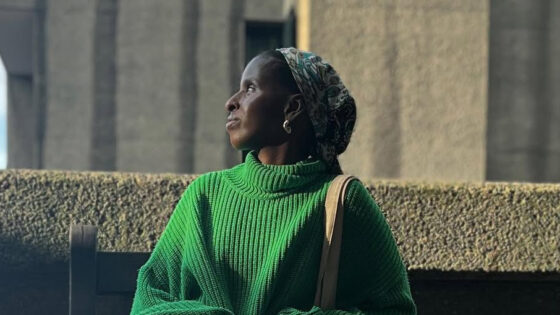
My name is Sara Bafo and I'm a writer and organiser from Somalia. You are listening to A World With and in this episode, I'll be adding no landlords. Right now I'm recording from my childhood home, a working class corner of West London. Rain taps slightly against the window. Cars pass every so often, their tires rushing over the wet road. I've lived in this council home for 20 years and from the same window I've watched the street change bit by bit. People have come and gone, each leaving something of themselves behind. I've spent years daydreaming about the lives of those who walk past this window, imagining where they're going and what they carry with them.
On our journey towards liberation my contribution to the world is no landlords. Growing up in my corner of West London, I witnessed the problems landlords create…thousands of empty homes sitting silently and untouched for months while families are shuffling between shelters and people are curled up on the cold streets.
This is the reality for many in the UK today: a place overflowing with empty houses but starving of homes. The 2024/2025 Combined Homelessness and Information Network recorded over 13 thousand people unhoused in London. Yet in the same year, the Ministry of Housing, Communities and Local Government recorded that there were over 93,000 homes in London sitting empty.
So why is this happening? I believe this is happening because in our current system, homes have become trophies for investment and not places to live. Landlords are so often distanced from the communities in which they own property and typically see houses as piggy banks rather than sanctuaries.
Growing up with my seven siblings, I learned that housing was more than a shelter. It was where I belonged.
Growing up with my seven siblings, I learned that housing was more than a shelter. It was where I belonged. I learned community by darting between council flats, sharing food, watching elders pool coins to help neighbours pay rent,and soaking in the gentle watchfulness of those who saw me grow.
These homes, run by the local council, gave families like mine rare security and affordability. Rents stayed low, not from cutting corners, but because the mission was simply to cover costs, not chase profit.
Council housing meant families like mine were provided a lifeline.
This is why I believe that everyone deserves access to homes free from landlords where homes would not be investments but essentials and universal.
In a world with no landlords, having a home would become a given, not a prize for those who can outbid others in a market that values profit over people. A world with no landlords means people enjoying stable, lasting homes free from the looming threats of eviction or sudden rent spikes. In a world with no landlords, homes are collectively owned, publicly managed, or run by cooperatives.
Some will say this world with no landlords is impossible. They'll claim housing markets are too entrenched or that property rights are untouchable.
But these arguments treat the current system as if it were nature itself. It isn’t. The fact that one person owns 20 homes while another has none is not a law of nature, it’s a choice made by the system we call capitalism, and one we can choose to undo.
A world with no landlords isn't about punishing people who rent out a spare room or inherit a flat. It’s about ending the idea that making money from someone else’s need for shelter is acceptable. That passive income from housing is somehow earned, while tenants working full-time jobs struggle to get by.
A world with no landlords is not about tearing down, but about building up
A world with no landlords is not about tearing down, but about building up. It is about creating a housing system rooted in care, fairness, and lasting wellbeing; a system designed for generations to thrive, not for capitalism to prosper.
So, to those who may be sceptical, know that removing landlords would not create chaos; but instead provide a solution that hands the keys to the community.
Tenants decide what gets repaired, where new homes are built, and how shared spaces flourish. Rents would mirror true costs, not the unpredictable tides of the market.
In every neighbourhood, quality homes would not be split into 'affordable' and 'luxury.' No one would be pushed into poor housing because of their income or background. With profit out of the picture, there would be no reason to pack people into cramped flats or let homes sit empty while others sleep outside just down the street.
I believe a world with no landlords sets people free.
In short, I believe a world with no landlords sets people free.
In this world, we will have more energy, mental space, and money reclaimed without worrying about letting agents who only follow the money and bow to the housing market.
With increased time, security, and ability to reprioritise, we will be able to retrain, care for loved ones, take risks, start small businesses, or give back to our communities in ways that go beyond a paycheck.
And it would be cities all over the world, like mine, in London who would feel the biggest change. Residents will decide what gets built and who it serves. Planning would finally put people first.
The exciting thing about a world with no landlords, is that we already hold fragments of this future.
Council housing, co-ops, tenant unions, and community land trusts already exist and show what’s possible when people unite to take homes out of the market. These are not just dreams; they are living models, even if starved of funding and recognition for years.
A world with landlords is needed because housing is too vital to be left to the market. It is to recognise that today’s stress, instability, and exploitation in renting are not fate- they are designed. And what is designed can always be redesigned for the masses.
A world with no landlords is not just a policy idea; it’s a vision of how things could work when people come before profit. It’s not utopian. It’s practical. It’s been done before, in different forms, in different countries like Cuba. And it can be done again.
So what are the practical steps we can take to get here? We begin by replacing power with courage. Piece by piece, brick by brick, we take back homes from the market and return them to the people who live in them.
It starts by reinforcing what already works: investing in council housing, growing co-ops, and protecting tenants with rent controls and eviction bans. We support community land trusts so the land beneath us belongs to all, not just the wealthy.
We tax empty homes, block corporate landlords from swallowing neighbourhoods, and ban second-home speculation where people cannot even afford a first.
But beyond policy, we rewrite the story. We stop calling housing a 'ladder' and name it what it truly is: a foundation. We build tenant unions that fight back and push forward, knowing every rent increase resisted, every eviction halted, every block organised is a brick in a new system. We resist the sell-off of our basic needs; we build a socialist world for and by the people.
This is how we make a world with no landlords possible. Not overnight, not by waiting for approval, but by making landlords obsolete, one community at a time, home by home.
My name is Sara Bafo and that's what a world with no landlords would sound and feel like. Thank you for listening! I can't wait to see what else we’ll add in the next episode.
A World With is produced by Futures in Draft and Storythings.