Full transcript text
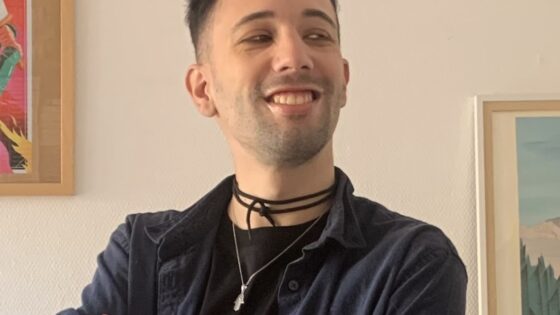
My name is Sam Sivapragasam and I’m a writer, grower and organiser from London. You are listening to A World With and in this episode, I will be adding land reparations.
I like to think that I'm from three different islands, the consequence of a history forged by colonialism. My grandfather was Sri Lankan Tamil. He met my grandmother who is white English, and my mother's parents are Black Jamaicans. My parents met in Jamaica where I was born. I moved to northwest London when I was seven, and I've spent most of my life in London.
I'm based in Southeast London right now, right by the busy and beautiful Old Kent Road, and I'm a founding member of Land in Our names, a grassroots collective addressing the inequalities in access to land and food.
On our journey to liberation my contribution is a world with land reparations.
I was born in Montego Bay, Jamaica, and I grew up in the hilly outskirts of the city. My childhood memories are filled with me running through the neighbour's farm, playing with local kids by the water hole, swimming in the crystal clear ocean, snorkeling and studying the coral reefs and hiding in the bush.
But when I moved to London, we first lived in a flat and my access to playing independently, exploring and running around became limited. Access to land and nature as a child has therefore shaped how I see the world and shaped my belief that children should have space to run free and wild. To play and discover, to feel safe and have all their needs met.
A world with land reparations therefore envisions and brings into being a future where colonial and futile land ownership is disrupted and land is redistributed fairly, ensuring that we all have the right to play, rest, heal, and grow food.
What I mean by disrupting colonial and feudal land ownership is changing the ways that land ownership operates in places like Britain and many of its current and former colonies. Land law in Britain dates back to mediaeval titles distributed by William the Conqueror to his supporters.
So what do I mean by a world with land reparations? Most simply land reparations are a form of restitution. Reparations call for the repair for the harms of colonialism through systems and institutions such as the transatlantic slave trade, the genocide of Indigenous peoples and the different atrocities and systems of exploitation forced onto colonised peoples worldwide.
Colonialism is when exploitative settlers from one country take full or partial political control over another country. Extraction and exploitation of resources, land and people under colonialism and its legacies have led to wealth flowing from the Global South to the Global North. And even after decolonisation, many newly independent nations were forced to take loans from their former colonial powers.
This has meant that formerly colonised countries spend more money paying off debts than investing in infrastructure such as schools, agriculture, or hospitals. This has had long lasting effects on countries and their populations for centuries.
A world with land reparations is one of the ways that repair can be achieved practically through the redistribution of land ownership from those who have benefited from colonialism to those who have been most affected by it.
I'm particularly connected to this topic of land reparations because for a long time in my organising work I've struggled to find a way of grounding political theories and practices. But land is something that you can touch and interact with, and in this way it makes visible many of the issues that affect us as individuals and communities, whether that is food, water, housing, and so on.
A world with land reparations is a way to undo inequality and to address the afterlife of colonialism with something real and practical, not just symbolic.
For me, a world with land reparations is a way to undo inequality and to address the afterlife of colonialism with something real and practical, not just symbolic. I'm also excited by a world with land reparations because it demands the remaking of the world by repairing the harm, not just to Black and brown people who are descended from colonised people, but also the land itself and to redistribute the land and wealth to those who do not have access.
For us to truly see the power and potential of a world with land reparations though, it's important for us to start to acknowledge how unequal land ownership is and how it is negatively impacting communities.
In Jamaica for example, agricultural land is unequally distributed. Most farmers can obtain only small plots through a tenure system based on kinship ties and have no written documentation of their rights to land. A small number of farmers control a disproportionate amount of farmland, monopolizing high-quality arable land and leaving small farms with marginal hillside land.
In the UK, land ownership is also unequal with many of the individuals and institutions owning land having directly benefited from colonialism.
Ownership is concentrated into the hands of a few wealthy individuals and families.. According to a 2019 study by Who Owns England, 1% of the population own more than 50% of the land in England, with 30% of land in the hands of the aristocracy and gentry.
This matters because who owns the land controls all the things that land offers: housing, food, leisure, etc.
We can work towards a world with land reparations by mapping land ownership both locally in Britain, and internationally, and identifying the connections to colonial institutions. Another method is to encourage wealthy individuals to redistribute resources to communities affected by colonialism.
On a holistic level, a world with land reparations can be enacted through communities affected by colonialism reconnecting with land and nature, wherever they are, and with their ancestral ways of being.
Beyond this, repair looks like providing opportunities for people displaced from land and nature to connect, both physically and spiritually. It means putting autonomy and stewardship into the hands of Indigenous Peoples, currently and formerly colonised peoples, to shape what an interdependent and intersectional conservation and restoration of ecosystems can look like.
So for me, I am passionate about the possibilities of a world with land reparations, because I believe it will shift the way that power is distributed globally.
In short, I believe it will remake the world.
As Malcom X says, "Revolution is based on land. Land is the basis of all independence. Land is the basis of freedom, justice, and equality."
In a world with land reparations, resources would be fairly distributed, with countries and regions rich in natural materials and minerals having sovereignty over how they are extracted and distributed.
Forests across the world will be tended through reciprocal and interdependent relationships. Our oceans, lakes and rivers will be clean and we will return to sustainable waste management and fishing practices.
We will draw from Afro-Indigenous farming and ecological practices, tending the land in reverence and gratitude. We will create spaces for rest, play and healing, prioritising community over commodities. Choosing connection, commitment, accountability and responsibility.
A world with Land Reparations is one of the ways that we can make material demands for land, housing, racial, climate and food justice.
I imagine a world with land reparations where the Global Majority are free to live our lives fully, in deep connection with the land and each other, and our communities are supported and resourced to flourish.
I see a world that treasures learning, care, imagination, cooperation and reciprocity. These are all the futures that a world with land reparations would make possible.
As Malcom X says, "Revolution is based on land. Land is the basis of all independence. Land is the basis of freedom, justice, and equality."
My name is Sam Sivapragasam and that’s what a world with land reparations would sound and feel like.
I can't wait to see what else we’ll add in the next episode. Thanks for listening!
A World With is an audio series produced by Futures in Draft and Storythings